
Fantasy football is mostly a thermodynamic exercise in convincing yourself that a guy running three routes against a Cover-2 shell is a lifestyle choice.
Every week, millions of managers stare at box scores like medieval monks interpreting goat entrails. They see a running back rush for 42 yards and panic, or they see a wide receiver haul in a long touchdown bomb and crown him the king of the universe. This is a rookie mistake. Raw yards lie because game scripts, weird bounces, and garbage-time accumulation distort reality. If you want to stop guessing and start understanding who actually owns the football, you have to look at touch share.
What Fantasy Football Touch Share Actually Measures
In simple terms, touch share calculates the exact percentage of a team's total offensive touches—defined strictly as rushing carries plus receptions—that belong to a specific player over a rolling three-week window. Why three weeks? Because a single game is noise, and a full season is history. A three-week window is the sweet spot where you catch the exact moment a backfield shifts, a target tree consolidates, or a coach finally realizes his veteran safety blanket is cooked. You can explore how these metrics look in practice by checking out the PDW Touch Share Dashboard.
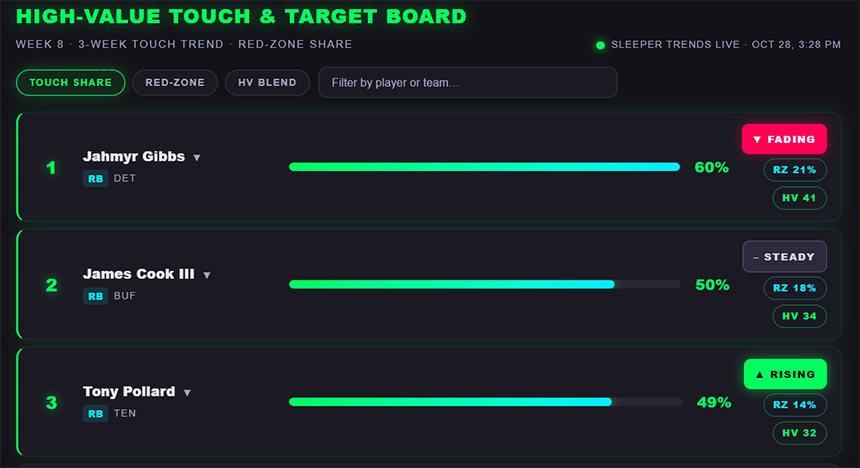
Consider how this plays out in real backfields across the league. When you look at a high-end weapon like Jahmyr Gibbs slicing through defenses, his volume isn't an accident of game flow; he routinely hovers around 60 percent of Detroit's total touches when you factor in the high-leverage passing game work. That is not just a player performing well; that is an entire offense being funneled through one human being. When you own 60 percent of a team's oxygen, your floor is practically bulletproof.
Red-Zone Share: The Ceiling Stat
Volume keeps you in the game, but touchdowns win matchups. That is where red-zone share enters the equation as the ultimate ceiling metric.
While general touch share tells you who is moving between the 20s, red-zone share tracks who gets the rock when the field condenses and the playbook shrinks. It measures a player's percentage of team touches inside the opponent's 20-yard line, backed by the rigorous three-week sum of red-zone touches from official game feeds.
Take a polarizing talent like Kyle Pitts. On any given Sunday, general box score watchers might look at a modest yardage total and shrug. But if you pull the underlying data, Pitts routinely hovers around a 33 percent red-zone share, leading the board in high-value usage despite erratic quarterback play. Yards can fluctuate based on weather and defensive coverages, but high-value red-zone opportunities are sticky. A player with an elite red-zone share is simply waiting for positive touchdown regression to explode your weekly score.
The HV Blend: Finding the Sweet Spot
To bridge the gap between floor volume and ceiling touchdowns, we use the High-Value blend, or HV blend. Calculated simply as the rounded average of a player's touch share and red-zone share, this metric serves as the primary sorting mechanism for serious fantasy analysis.
The underlying thesis is straightforward: volume is your floor, and red-zone work is your ceiling. A player who commands both is occupying the golden spot that separates weekly starters from championship winners. When Tony Pollard drops a monster line like 129 total yards and three touchdowns in a single week—as he did during his standout Week 7 performance—it is rarely a random stroke of luck. It is the predictable byproduct of a high HV blend where the coaching staff trusts him to handle both the grind between the checkboxes and the execution inside the paint.
The Trend Rule and Market Signals
Numbers on a spreadsheet are only valuable if you know when they are moving. That brings us to the trend rule, which operates on a simple principle: real movement flips on actual performance deltas or market aggression, not gut feelings or media hype.
A player's trend badge flips to rising if their latest weekly performance jumps by 3.0 or more fantasy points compared to their oldest week in the window, or if 48-hour waiver wire market adds outpace drops by a 2-to-1 margin. Conversely, a drop of 3.0 points or a wave of panic-drops flips the badge to fading.
This brings in the crowd-signal layer. Player trends and metric feeds are sourced via Sleeper API, capturing the frantic pulse of hundreds of thousands of managers scrambling on waivers before the Tuesday FAAB deadline locks. When the market surges toward an emerging pass-catcher, the underlying numbers usually validate the panic long before the mainstream talking heads catch up.
Using Touch Share on the Waiver Wire
Knowing the math is interesting, but weaponizing it is how you clear out your league's prize pool. This is where your weekly waiver wire strategy transforms from a guessing game into an extraction operation.
When you are scanning the wire for a hidden gem or evaluating a risky waiver claim, stop looking at last week's raw fantasy points. Look at the touch share trend. If a backup running back stumbles into two touchdowns on three carries, the box score chasers will blow their entire FAAB budget on a ghost. But if you check the dashboard and see a 12 percent touch share with zero red-zone involvement, you are looking at an expensive trap.
Conversely, when an unheralded rookie or a secondary receiver quietly creeps up to a 20 percent touch share and a rising trend badge over a three-week sample, you pounce. You are buying the volume before the touchdowns arrive. It is the exact same discipline required when evaluating whether to accept a trade or how to set your lineup flex. If you want to see how these metrics organize the top 20 high-value players right now, head over to the PDW Touch Share Dashboard and sort by the HV blend.
Fantasy football is an absurd game played by stressed-out adults in basement offices across America. You can let the chaos dictate your roster, or you can track who actually owns the football. The choice is yours.
Comments (0)
No comments yet. Be the first to weigh in.
Join the Discussion
Login with Google to leave a comment.
Login to Comment